Day Snowmelt RGB
Alternative name: Snowmelt RGB
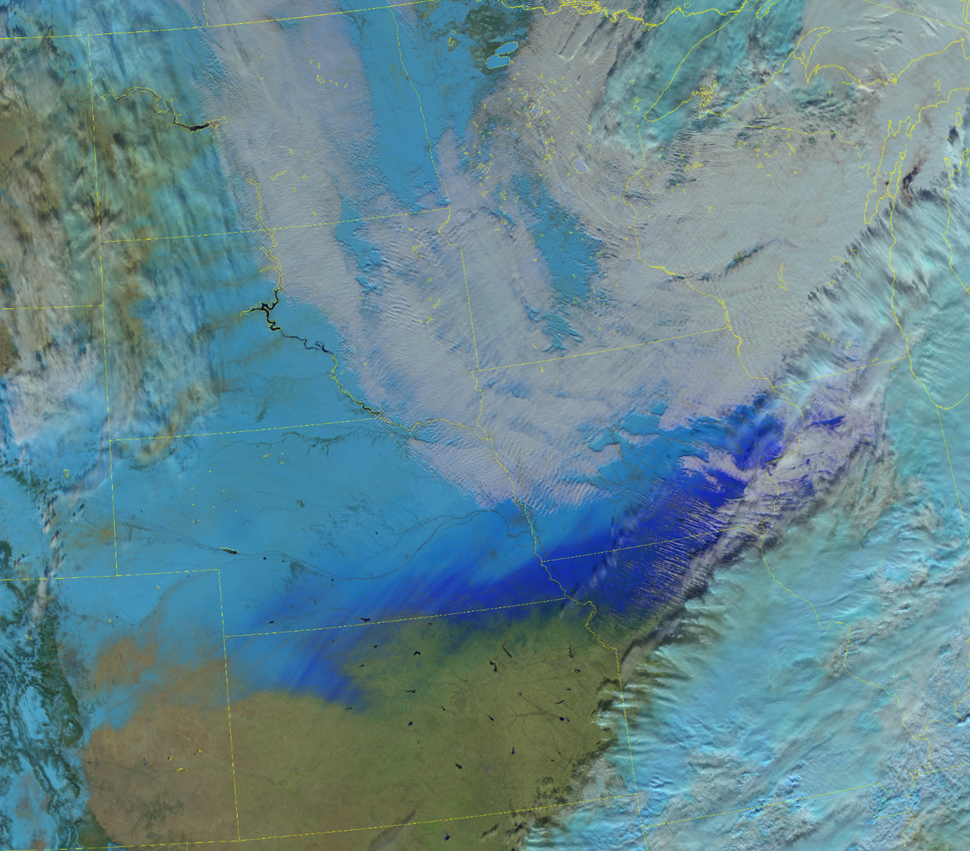
Main applications
- Characterization of surface snow and ice properties.
- Detection of freezing rain, sleet, mixed precipitation, or ice pellet accumulations.
Remarks
- Dry snow and small-grain snow typically appear light blue to cyan. Wet snow and large-grain snow appear medium to dark blue, while freezing rain, sleet, or ice pellet accumulations tend to appear dark blue. Imagery has a similar appearance and interpretation as the Day Land Cloud RGB.
- This RGB can be used to detect fresh snow on top of older snow, and rain-on-snow features.
- As snow ages, melts, or partially melts and re-freezes, its brightness decreases, appearing darker in the imagery. This darkening suggests reduced potential for snow to be lofted by high winds, making this RGB valuable for use alongside with the Blowing Snow RGB to monitor for ground blizzards.
- This RGB may be used to detect potential avalanche conditions, though interpretation can be challenging due to terrain- and forest-induced shadows, and cloud cover.
- Utilizes the NIR1.24 channel, which is not currently available on any geostationary satellites.
VIIRS Day Snowmelt RGB
| Colour beam | Channel (difference) | Range min | Range max | Unit | Gamma |
|---|---|---|---|---|---|
| Red | NIR1.61 | 0 | 125 | % | 2.0 |
| Green | NIR1.24 | 0 | 125 | % | 2.0 |
| Blue | VIS0.64 | 0 | 125 | % | 2.0 |