Day Fire RGB
Alternative names: Day Land Cloud Fire RGB, Natural Fire Colour RGB
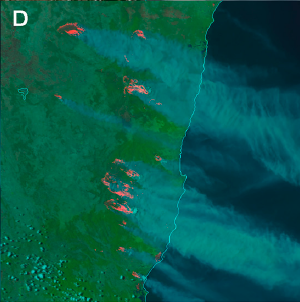
wildland fires in southeast Australia
This RGB has two commonly used variants, depending on whether the red colour beam uses brightness temperature (IR3.8) or reflectance (IR3.8refl).
Variant 1: Using IR3.8 (Brightness Temperature)
Main applications
- Detection of active fires and associated smoke plumes.
- Enhanced visualization of vegetation and burnt areas.
Remarks
- This RGB does not provide information on fire intensity.
- Sensitive to moderately hot or sub-pixel fires.
- Very hot surfaces may mask fire signals by saturating red channel.
Day Fire RGB
| Colour beam | Channel (difference) | Range min | Range max | Unit | Gamma |
|---|---|---|---|---|---|
| Red | NIR3.8 | 273 | 333* | K | 0.4 |
| Green | NIR0.86 | 0 | 100 | % | 1.0 |
| Blue | VIS0.64 | 0 | 100 | % | 1.0 |
- In hot and arid regions, the upper limit of the red range is recommended to be adjusted to 343 K to avoid saturation under non-fire conditions (as also advised for the Fire Temperature RGB).
Variant 2: Using IR3.8refl (Reflectance)
Main applications
- Detection of active fires and associated smoke plumes.
- Enhanced visualization of vegetation and burnt areas.
Remarks
- This RGB does not provide information on fire intensity.
- Sensitive to moderately hot or sub-pixel fires.
- The background appears less red over hot land surfaces compared to Variant 1, making fire detection more distinct.
- Provides improved colour contrast between actively burning and burnt/smouldering pixels compared to Variant 1. However, Variant 1 may still be preferred for precise fire perimeter mapping (Seaman et al., 2023).
Day Fire RGB
| Colour beam | Channel (difference) | Range min | Range max | Unit | Gamma |
|---|---|---|---|---|---|
| Red | NIR3.8refl | 0 | 50 | % | 1.0 |
| Green | NIR0.8 | 0 | 100 | % | 2.0 |
| Blue | VIS0.6 | 0 | 100 | % | 2.0 |