Day Moisture RGB
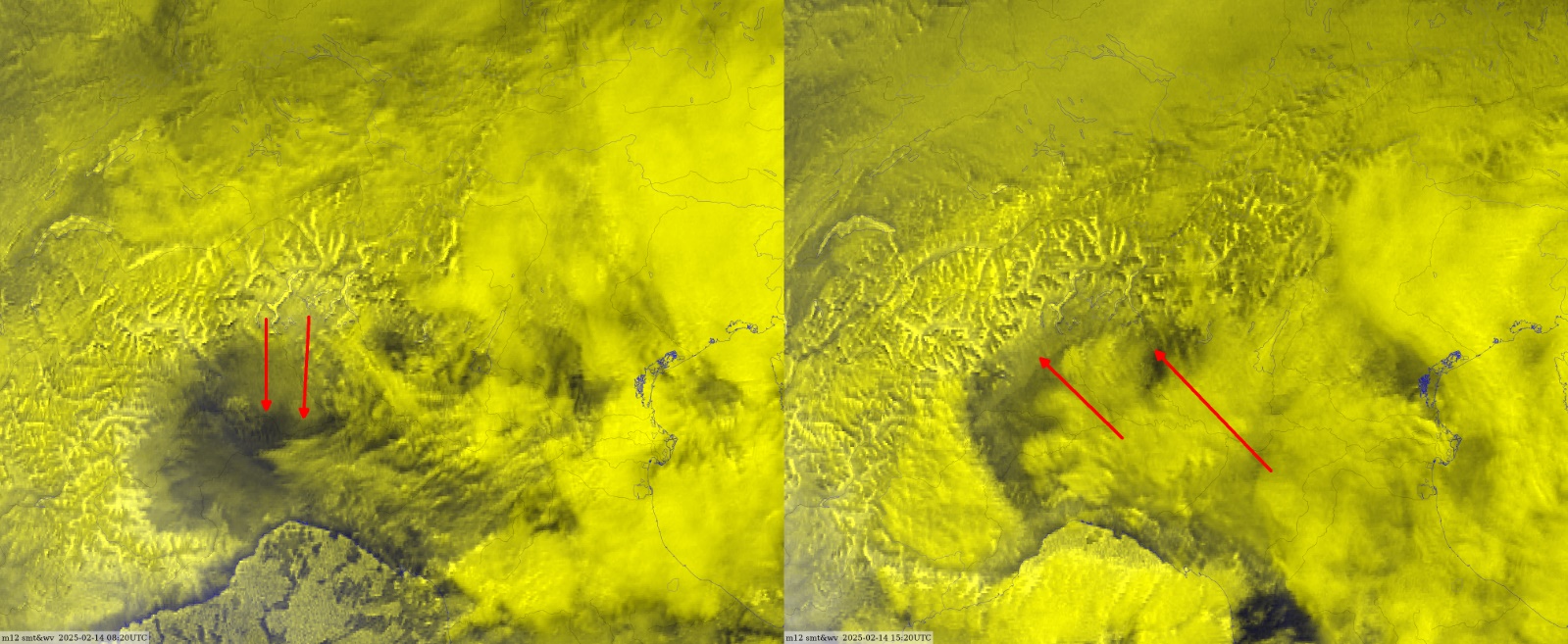
Main applications
- Detection and monitoring of low level (ie total column) moisture fields.
Remarks
- This RGB is newly introduced to MTG FCI.
- Among current GEO imagers, only FCI includes the NIR0.9 band, enabling this RGB.
- Uses a ratio of NIR0.9/VIS0.8 (rather than channel difference).
- Proposed names for this RGB include Water Vapour Transmittance or Total Moisture Imagery to better describe this composite.
- The NIR0.91 channel provides information on vertically integrated water vapour content in the atmosphere (typically dominated by lower tropospheric levels).
Reference: Gao & Kaufman (2003), Water vapor retrievals using Moderate Resolution Imaging Spectroradiometer (MODIS) near-infrared channels, J. Geophys. Res., 108(D13), 4389. https://doi.org/10.1029/2002JD003023.
Development Notes
- Several RGB variants using the NIR0.9/VIS0.8 ratio are under testing.
- Neither the final recipe nor the name of this RGB has been finalized.
- qTPW (quasi-Total Precipitable Water): best visualized through (fast) animations, enabling quasi cloud masking as perceived by the human eye.
- No solar zenith angle correction needed neither for "smt" (NIR0.9/VIS0.8 ratio) nor for the Day moisture RGB.
On the figure below:
- Left image: foehn phase in the early morning -- bright area spreading south.
- Right image: easterly backflow (bora type) over Po Valley in the afternoon -- dark area under clouds advancing westward.
- No clear sign of moisture fields in compared Dust RGB.
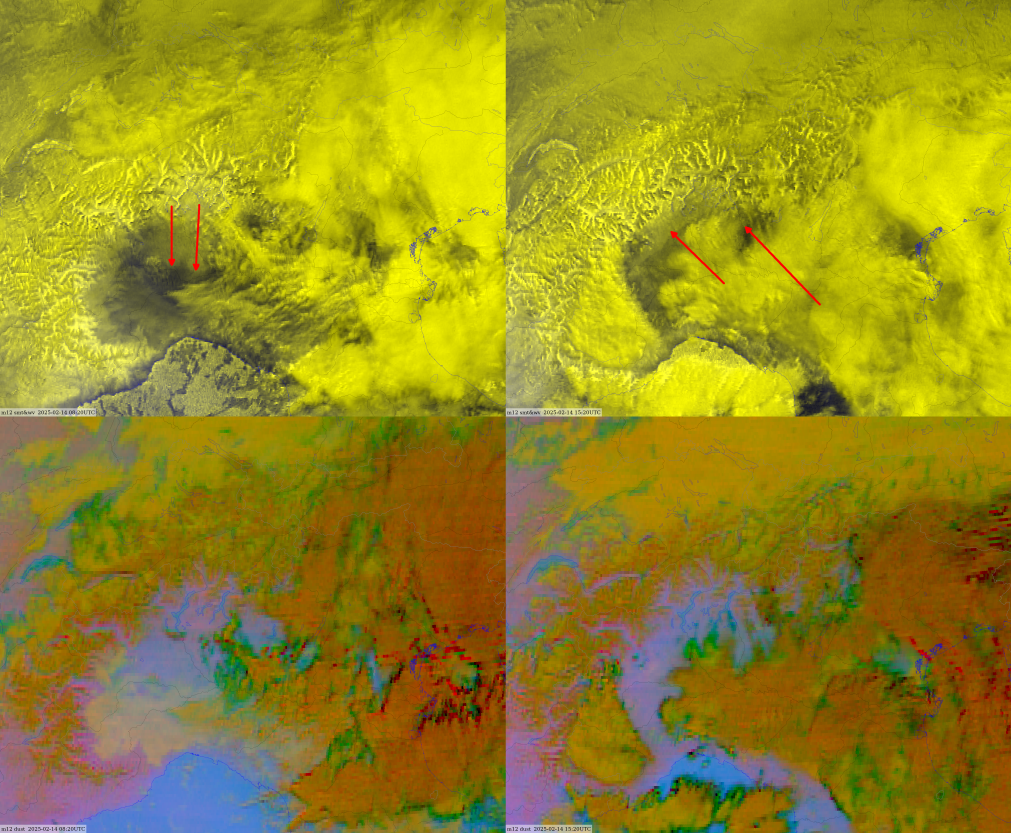
14 February 2025, 14:08 & 15:20 UTC
Preliminary FCI Moisture RGB
| Colour beam | Channel (difference) | Range min | Range max | Unit | Gamma |
|---|---|---|---|---|---|
| Red | NIR0.9/VIS0.8 | 0.6 | 1 | 0.8 | |
| Green | NIR0.9/VIS0.8 | 0.6 | 1 | 0.8 | |
| Blue | WV7.3 | 230 | 270 | K | 0.3 |
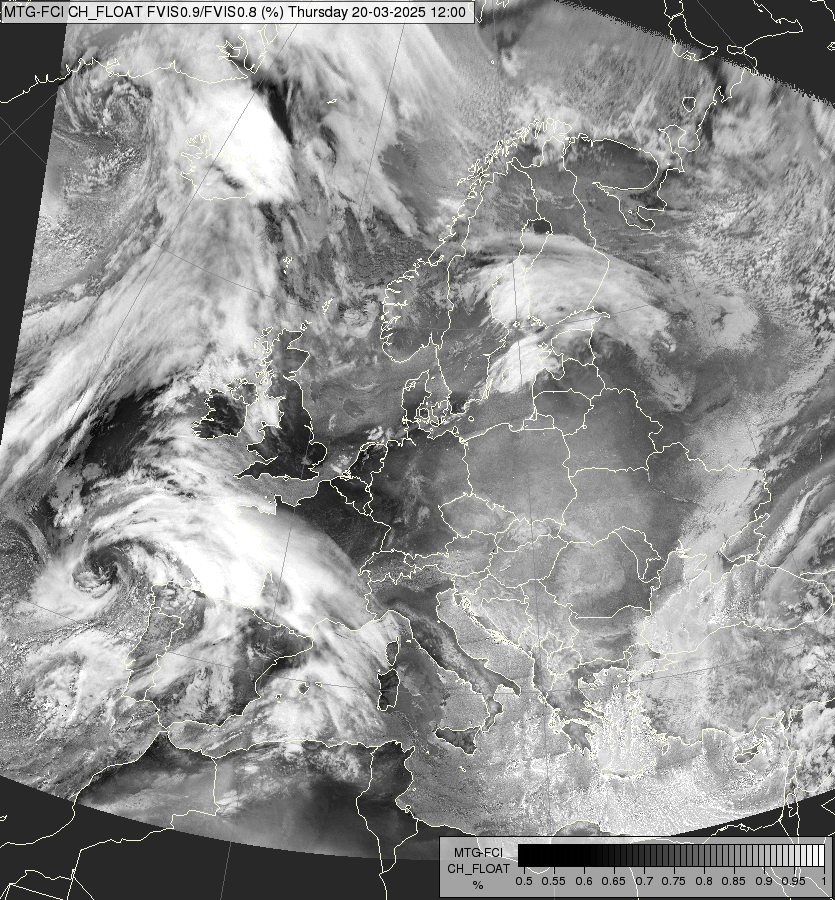
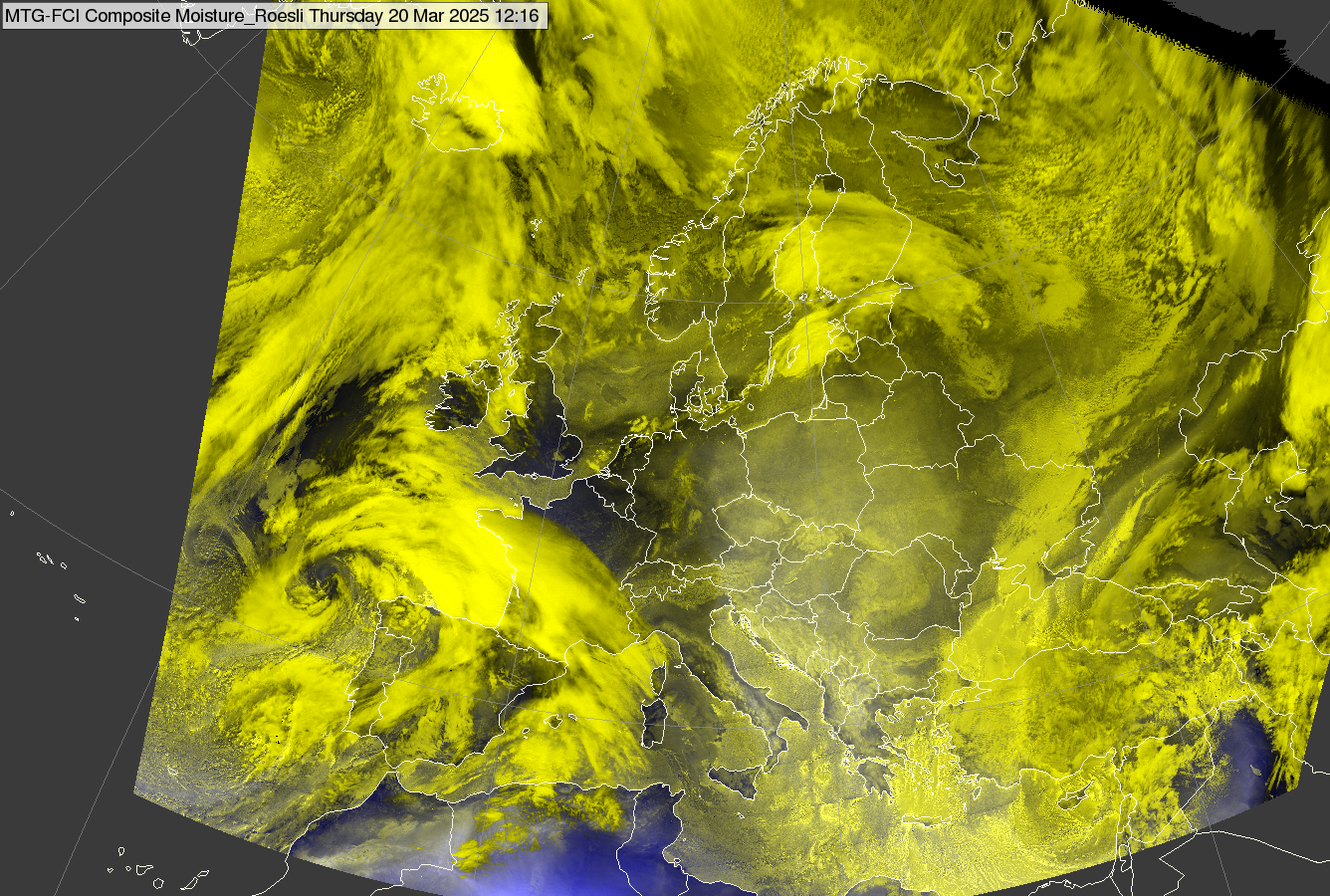
Météo-France tested three different algorithms to enhance the visualization of moisture fields: two RGB variants and ESSL visualization (using NIR0.9/VIS0.8 ratio):

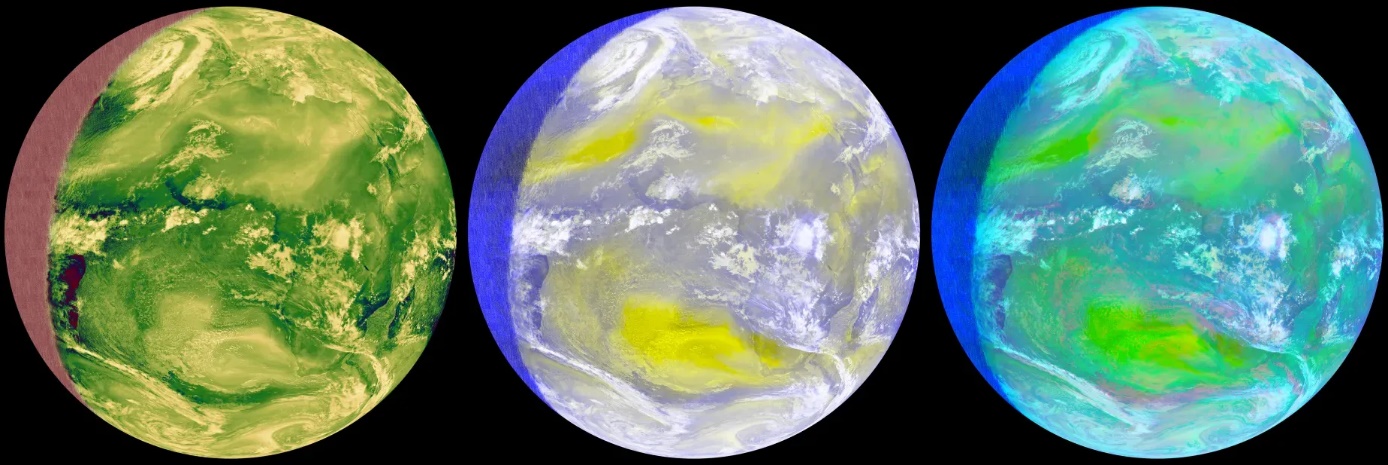
ESSL Colour Palette Version (Left Image)
- NIR0.9 / VIS0.8 visualized with a colour palette.
RGB Variant 1 (Right Image)
Uses the following RGB configuration:
| Colour beam | Channel (difference) | Range min | Range max | Unit | Gamma |
|---|---|---|---|---|---|
| Red | VIS0.6 | 0 | 100 | % | 1.4 |
| Green | NIR0.9/VIS0.8 | 0 | 100 | % | 1.0 |
| Blue | WV7.3 | 270 | 230 | K | 3.3 |
H.-P. Roesli Variant (Middle Image)
Same green and blue component as variant 1, but applies different gamma settings for the blue channel (exact value range is not confirmed).
| Colour beam | Channel (difference) | Range min | Range max | Unit | Gamma |
|---|---|---|---|---|---|
| Red | VIS0.9/VIS0.8 | 0 | 100 | % | 1.0 |
| Green | NIR0.9/VIS0.8 | 0 | 100 | % | 1.0 |
| Blue | WV7.3 | 270 | 230 | K | 3.3 |
Next steps / recommendations
- Determine whether this RGB provides significant benefits over a simple SMT (VIS0.9/VIS0.8 ratio) imagery.
- Explore the inclusion of additional channels to diversify input (currently, both red and green beams rely on similar ratio inputs).
- Consider adding cloud-sensitive channels (e.g., NIR1.38, NIR0.91, VIS0.8), as current output may appear overly yellow.